Quick answer: what is a WDT tool?
A WDT tool uses fine needles to break up clumps and redistribute espresso grounds before tamping. Use it after dosing and before tamping: work gently through most of the coffee bed without forcefully scraping the basket, then finish with shallow passes to level the surface. WDT can reduce the risk of uneven flow, but it cannot correct the wrong grind size, dose or an unlevel tamp.

What Does WDT Stand For?
WDT stands for Weiss Distribution Technique. It is named after John Weiss, a home espresso enthusiast who introduced the method to the online coffee community in 2005.
The technique uses one or more fine needles to break up clumps and redistribute loose espresso grounds inside the portafilter basket before tamping. Its goal is not to compress the coffee or simply smooth the surface, but to create a more even coffee-bed density, which can help reduce the risk of channeling and make espresso preparation more repeatable.
Today, the term WDT tool refers to the needle tool used to perform this technique, whether it is manual, rotating, or electric.
How to Use a WDT Tool for Espresso
Using a WDT tool correctly is not about stirring the coffee as quickly or aggressively as possible. The goal is to redistribute the grounds throughout the coffee bed while creating as little additional disturbance as possible.
For most home espresso workflows, we recommend working from the deeper grounds toward the surface, then finishing with a few lighter movements to level the top before tamping.
-
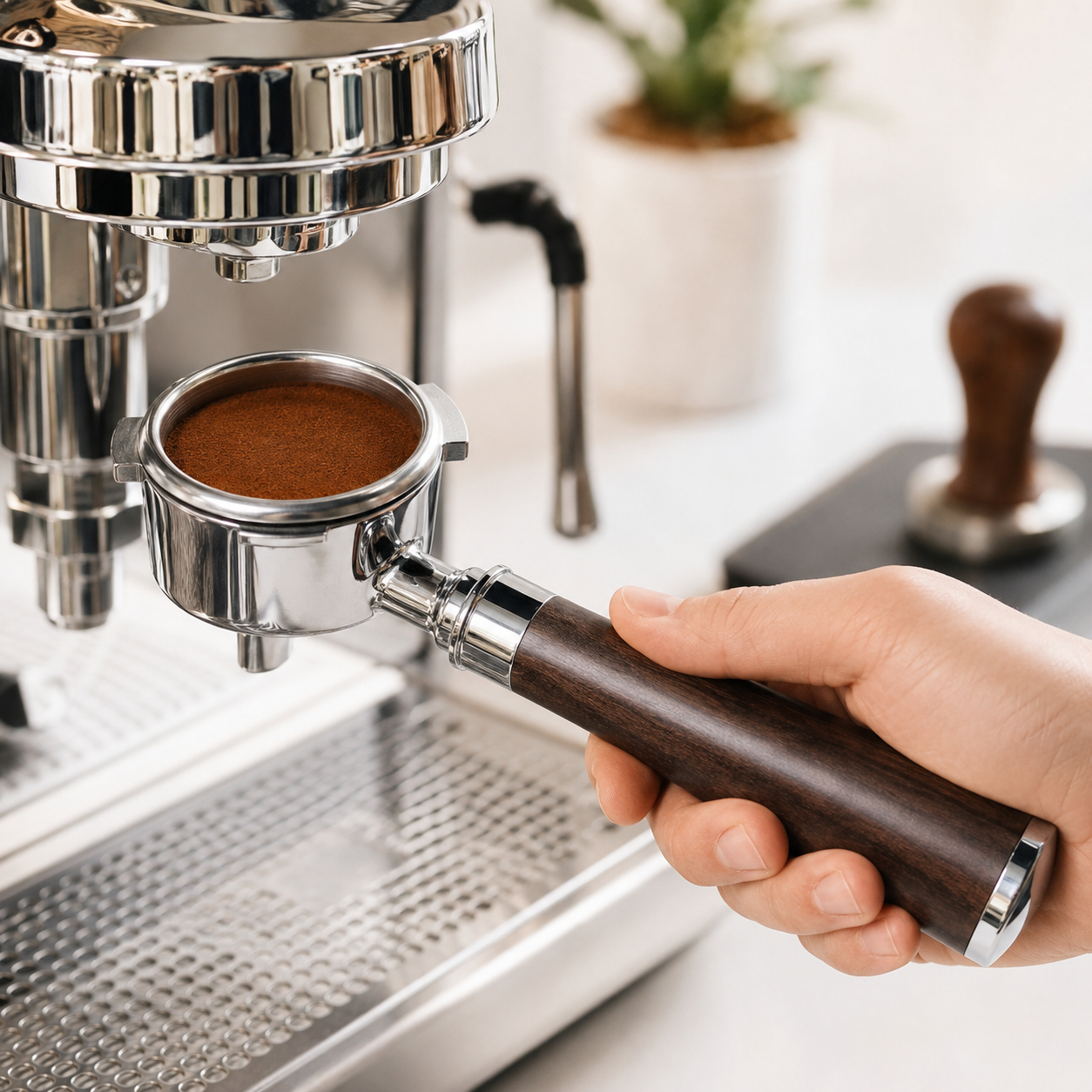
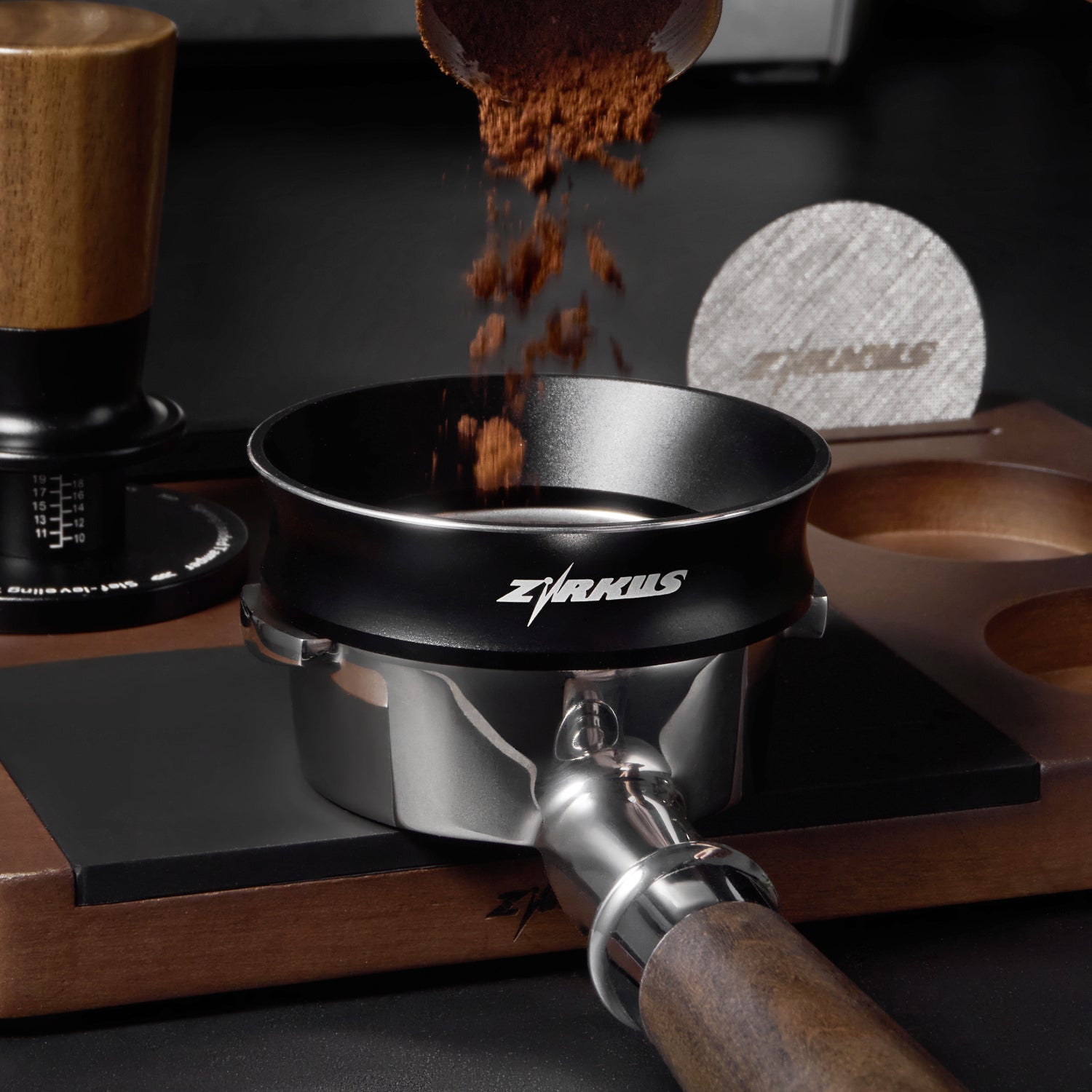
Dose into a clean, dry basket. Grind the measured coffee dose into the portafilter basket. Place a dosing funnel on the basket if needed to prevent grounds from spilling during distribution.

-
Move the needles through the deeper coffee bed. Lower the WDT needles gently so they pass through most of the coffee bed and reach close to the bottom. Do not press down forcefully or repeatedly scrape the metal basket. Surface-only raking may make the top look smoother while leaving clumps or uneven density underneath.

-
Distribute the lower layers first. Use small, overlapping circles or loops around both the edge and the center of the basket. Keep the movement controlled and use very little downward pressure. The purpose is to break up clumps and move coffee from high-density areas toward lower-density areas—not to whip or aerate the grounds.

-
Gradually work toward the surface. As the deeper grounds become more evenly distributed, raise the needles and use lighter, shallower movements across the top. Move any visible high spots toward low spots until the surface is approximately level.

-
Stop when the coffee bed is evenly distributed. The grounds should no longer contain obvious dense clumps, and the surface should look reasonably level without large piles around the center or basket wall. More stirring is not automatically better; excessive or uneven movement can create new differences in density.

-
Remove the tool, tamp and brew. Lift the WDT tool out carefully. If the coffee bed is still very fluffy, one gentle vertical tap can help it settle below the basket rim. Avoid hard side taps, which may shift the grounds to one side. Tamp once with the tamper level, then pull the espresso shot.

How Deep Should WDT Needles Go?
The needles should move through most of the coffee bed, including the lower grounds where hidden clumps may remain. The objective is not to scratch the basket floor, but the technique should be deeper than simply combing the top few millimeters.
Start near the bottom, distribute the full depth of the bed, and finish with shallow movements across the surface. This deep-to-shallow method provides a more complete distribution routine than surface raking alone.

Using a Rotating or Electric WDT Tool
For a rotating or electric WDT tool, first confirm that the tool matches your basket diameter. Center it over the basket and adjust the needle depth, if the model allows, so the needles can move through the coffee bed without scraping the basket. Allow the mechanism to complete its normal distribution movement, then remove the tool before tamping.

What Should You Expect After Using WDT?
A well-executed WDT routine can reduce clumps and make the density of the coffee bed more even. You may notice more repeatable shot times, a cleaner bottomless-portafilter flow or slightly greater puck resistance. A shot may therefore run a little slower after WDT even when the grind setting has not changed.
However, WDT does not guarantee channel-free extraction, thicker crema or better flavor in every shot. It cannot correct an unsuitable grind size, an incorrect dose, excessive or insufficient headspace, a damaged basket or an unlevel tamp. Treat WDT as one controlled step in the complete puck-preparation workflow—not as a cure for every espresso problem.
What Makes a Good WDT Tool?
A good WDT tool should move through espresso grounds with minimal resistance while reaching enough of the coffee bed to break up clumps and reduce uneven density. A higher needle count, heavier body or electric motor does not automatically produce better distribution. Needle diameter, spacing, depth, basket compatibility and control should be considered together.
| Feature |
What to Look For |
Why It Matters |
What to Avoid |
Needle diameter
A practical starting point
|
Fine needles around 0.3–0.4 mm |
Fine needles can break up clumps while moving less coffee through the basket. |
Thick wires that push large sections of coffee around. |
Needle spacing
Coverage without crowding
|
Needles spaced widely enough to move through the coffee without acting like a solid rake. |
Balanced spacing helps distribute grounds across both the center and edges. |
Too many tightly grouped needles that move the coffee as one mass. |
Working depth
Full-bed distribution
|
Needles long enough—or adjustable—to reach near the bottom of the basket without forceful scraping. |
WDT should redistribute the entire coffee bed, not only smooth the surface. |
Needles that only reach the top layer or scrape aggressively against the basket. |
Basket compatibility
Correct fit and coverage
|
A tool size and working area that match your portafilter basket. |
Proper compatibility makes it easier to reach the basket edges without spilling grounds. |
A rotating base that is too large, too small or unstable on the basket. |
Needle quality
Flexible and replaceable
|
Straight, corrosion-resistant needles that can be cleaned and replaced when necessary. |
Good needles maintain predictable movement and extend the useful life of the tool. |
Brittle, permanently bent or difficult-to-replace needles. |
Control and stability
Repeatable movement
|
A comfortable handle or a stable rotating mechanism with controlled movement. |
Better control reduces accidental digging, uneven movement and coffee spills. |
Loose mechanisms, uncomfortable grips or uncontrolled high-speed movement. |
Cleaning and storage
Easy daily maintenance
|
Accessible needles plus a stand, sheath or retractable design. |
Easier cleaning prevents coffee residue buildup and protects the needles between uses. |
Enclosed areas that trap grounds or exposed needles with no safe storage. |
Bottom line: A good WDT tool is not defined by needle count or automation alone. It should use appropriately fine, well-spaced needles, reach the required working depth and give you controlled, repeatable coverage of your coffee basket.
Once these fundamentals are met, the next decision is choosing the mechanism that best fits your workflow: manual, rotating, gear-driven or electric.
Types of WDT Tools: Manual vs Rotating vs Electric WDT
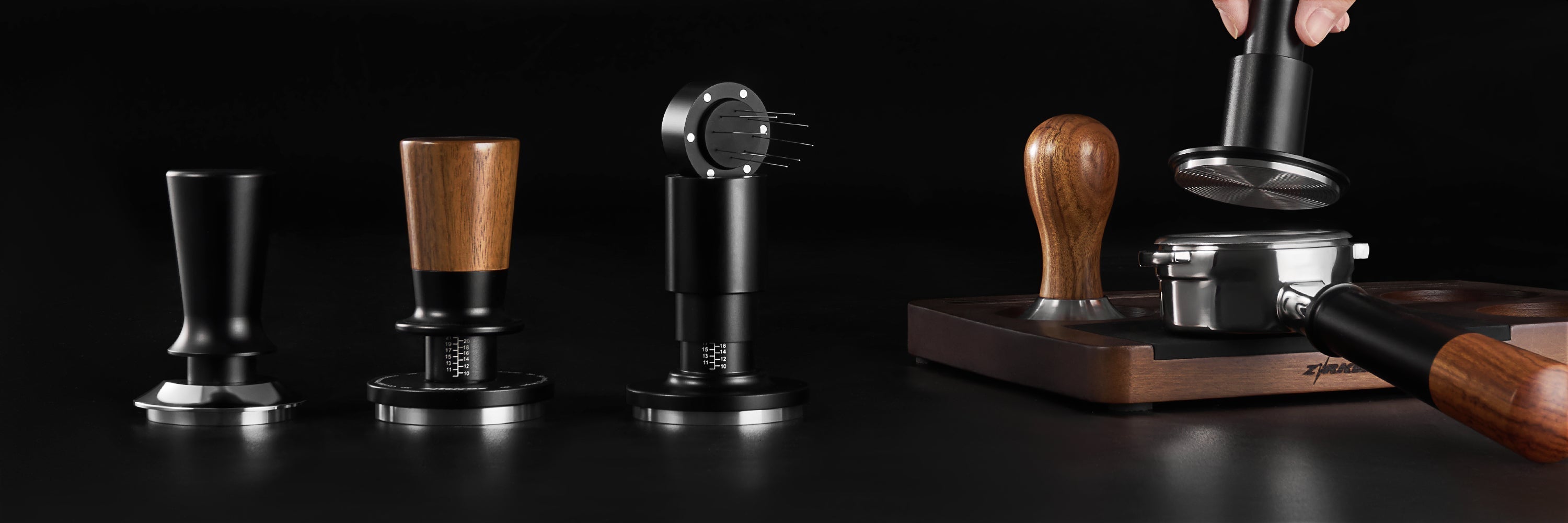
WDT tools can be divided into three broad categories: manual, rotating and electric. All three are designed to break up clumps and improve the distribution of espresso grounds, but they differ in how much control, speed and automation they provide.
The best choice is not necessarily the most expensive or most automated tool. It depends on your basket size, preferred workflow, daily brewing volume and how much direct control you want over needle depth and movement.
1. Manual WDT Tool
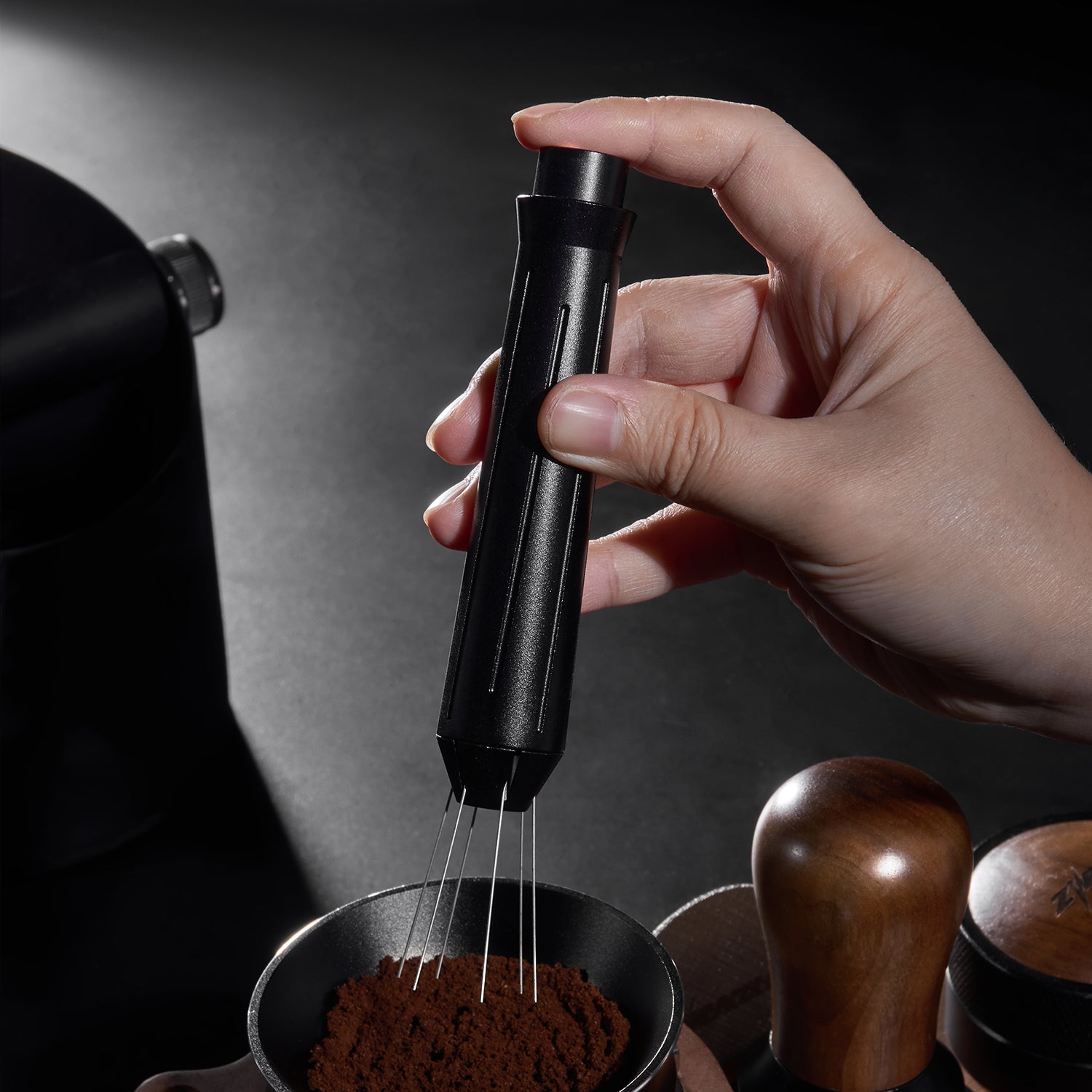
A manual WDT tool uses a fixed set of fine needles attached to a handheld grip. You control the working depth, movement pattern and distribution time by moving the tool through the coffee grounds yourself.

Manual WDT tools provide the most direct control and are usually compact, easy to clean and compatible with a wide range of basket sizes. However, their results depend more heavily on your technique. Moving too quickly, stirring only the surface or repeatedly working one area can create uneven density instead of correcting it.
Best for: Beginners who want an affordable starting point, users who prefer direct control and home baristas who use more than one basket size.
2. Rotating WDT Tool
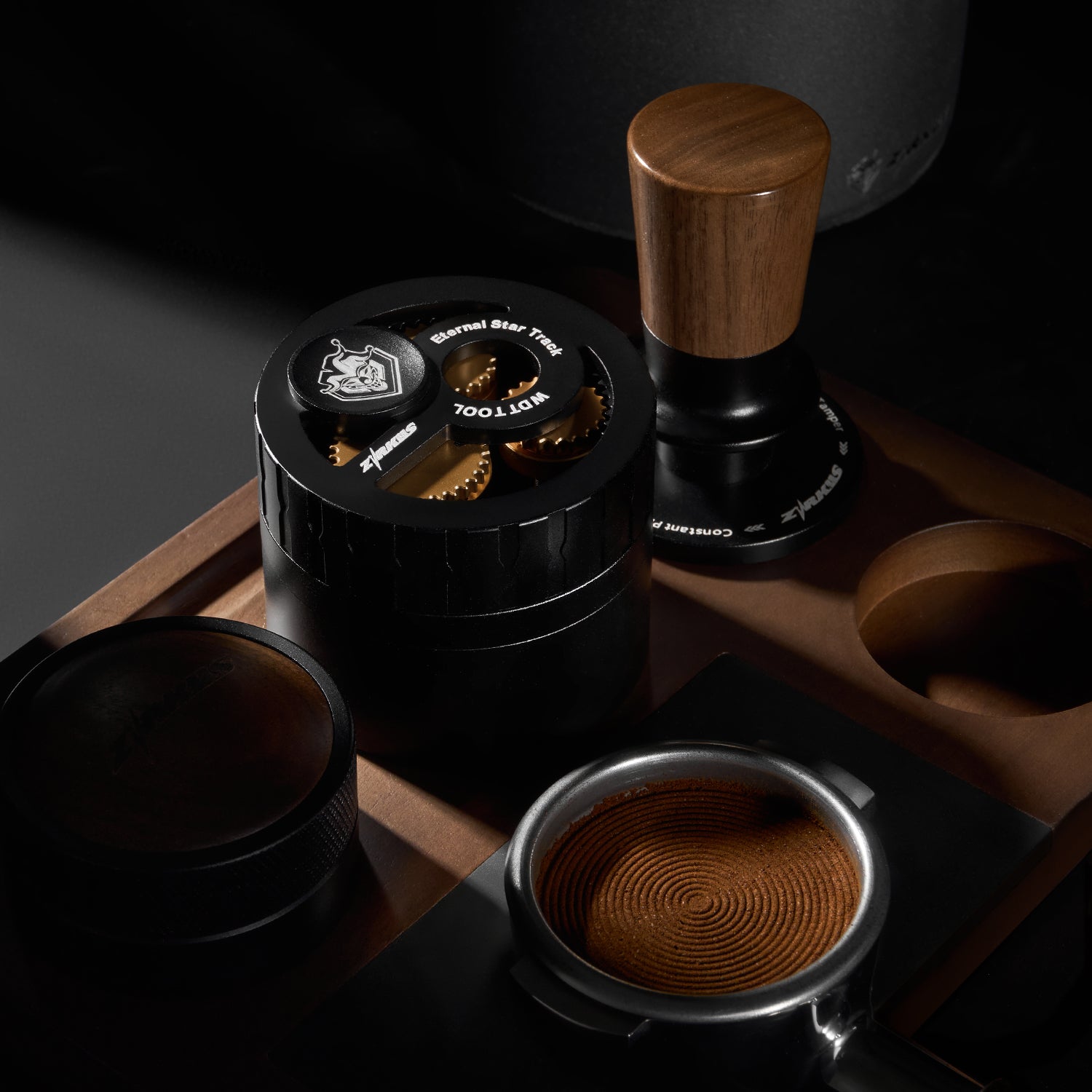
A rotating WDT tool uses a guided mechanical movement instead of completely freehand stirring. Depending on the design, the needles may be driven by a push-down mechanism, springback system, rotating top or planetary gear. These tools are sometimes also described as spinning WDT tools.

The guided needle path can reduce hand movement and make the preparation routine easier to repeat. Rotating models are useful for people who want a faster workflow without relying on a motor or battery. However, the tool must be centered correctly, and its basket size and needle depth should match the espresso setup. A guided movement cannot compensate for incorrect fit or poorly adjusted needle depth.
Best for: Daily home baristas who want a balance of manual control, faster preparation and more repeatable needle movement.
3. Electric WDT Tool
An electric or automatic WDT tool uses a motor to rotate the needles through the coffee bed. Depending on the model, it may use replaceable batteries, a rechargeable power system, automatic magnetic activation or a manual power switch.

Electric WDT tools require the least hand movement and can provide a steady operating speed, making them useful for frequent brewing or users who prioritize convenience. However, they are generally larger, more complex and more expensive than manual tools. Basket compatibility, needle depth, cleaning requirements and the power system should all be checked before buying.
Best for: Frequent espresso makers, users who want to reduce repetitive hand movement.
| WDT Tool Type |
Best For |
Main Advantage |
Consider Before Buying |
Choose This If... |
Manual WDT Tool
Best for control and value
|
Beginners, budget-conscious home baristas and users with multiple basket sizes |
Gives you direct control over needle depth, movement pattern and distribution time |
Requires more technique and usually takes slightly longer than a guided rotating tool |
You want a compact, affordable tool with maximum control and no basket-specific mechanism |
Rotating WDT Tool
Best balance of speed and control
|
Daily home users who want a faster and easier-to-repeat puck-preparation routine |
Uses a guided push-down, springback or gear-driven path with less freehand movement |
Basket diameter and needle depth must be compatible; movement patterns differ between designs |
You want repeatable guided movement without batteries, charging or a motor |
Electric WDT Tool
Best for convenience
|
Frequent brewers, users with limited hand movement and compatible high-volume setups |
Provides motorized needle movement at a steady operating speed with minimal manual effort |
Usually costs more and requires correct basket fit, power maintenance and careful cleaning |
You value automation and reduced hand movement more than compact size or the lowest price |
Which type is best? A well-used manual WDT tool can perform better than an incorrectly adjusted rotating or electric model. First confirm needle quality, working depth and basket compatibility, then choose the mechanism that best matches your preferred workflow.
Do You Need a WDT Tool?
Short answer: A WDT tool is not essential for making espresso, but it can be a useful and relatively simple way to improve puck distribution—especially when your grinder produces clumps or deposits coffee unevenly in the basket.
When used correctly, WDT can break up clumps and redistribute coffee throughout the basket before tamping. This may reduce the risk of channeling and make shot resistance, extraction time and flavor more repeatable. However, it cannot compensate for an unsuitable grind size, an incorrect dose, poor headspace or an uneven tamp.
You Are More Likely to Benefit From WDT If:
- Your ground coffee contains visible clumps.
- Your grinder leaves an uneven mound or deposits most of the coffee on one side of the basket.
- Your shot times or flavors vary noticeably even when dose, grind setting, yield and tamping remain consistent.
- You frequently see signs of channeling despite using an appropriate recipe and a level tamp.
- You want a more repeatable home espresso preparation routine and do not mind adding a few seconds to the workflow.
You May Not Need WDT If:
- Your grinder already produces fluffy, evenly distributed grounds with very few clumps.
- Your espresso shots are consistently balanced and repeatable without an additional distribution step.
- Speed is more important than small improvements in puck preparation.
Is a WDT Tool Worth It?
The most reliable way to decide is to compare your own results. Prepare several pairs of shots using the same coffee, dose, grind setting, yield and tamping method. Use WDT for one shot in each pair and skip it for the other.
Compare flavor, shot-time variation and overall workflow—not only how the extraction looks through a bottomless portafilter. If WDT repeatedly produces better-tasting or more consistent espresso, it is worth keeping in your routine. If the difference is negligible, your grinder and current distribution method may already be doing the job well.
Bottom line: WDT is helpful rather than mandatory. Use it when it solves a real distribution or consistency problem—not simply because it has become a popular espresso accessory.
WDT vs Distributor vs Tamper: The Correct Order
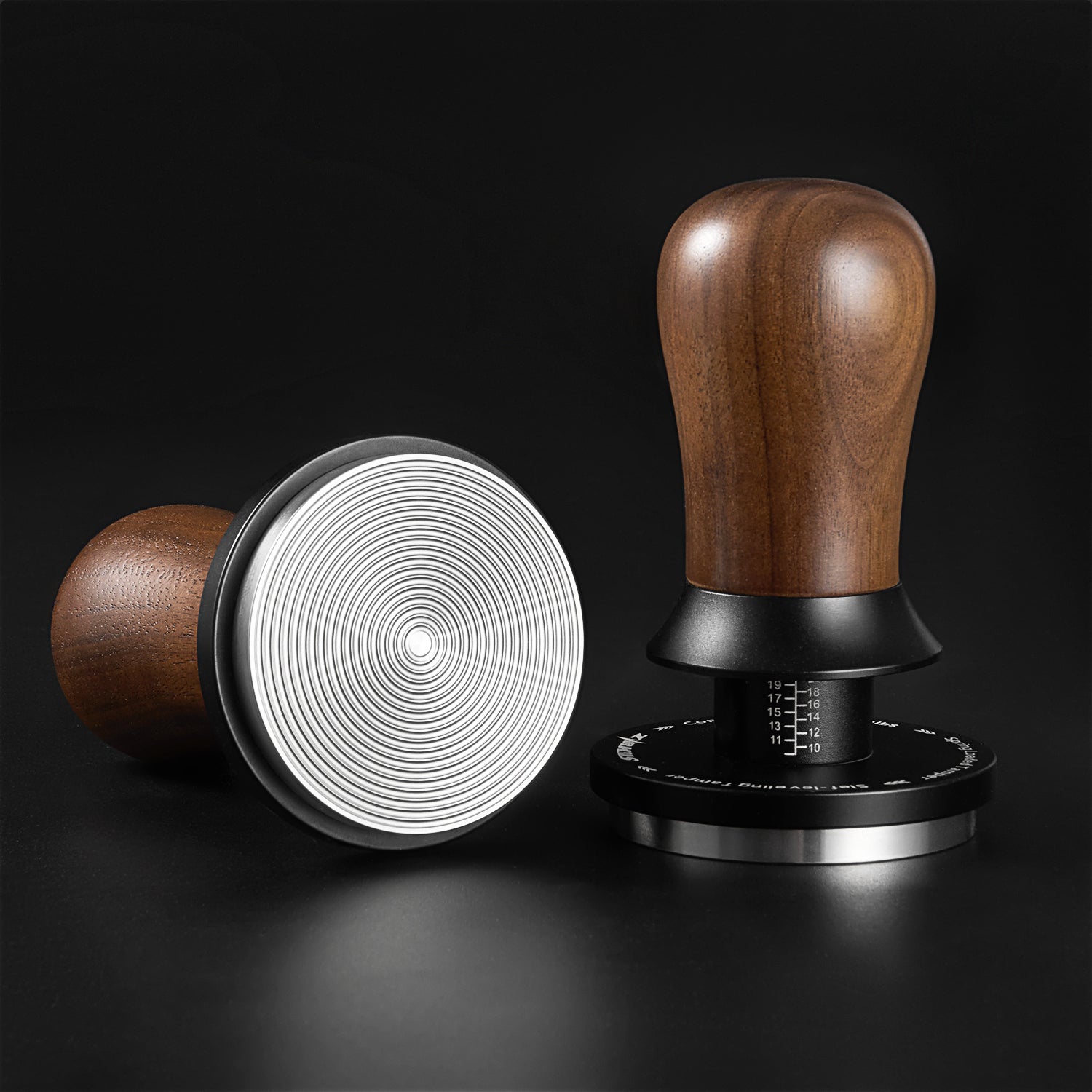
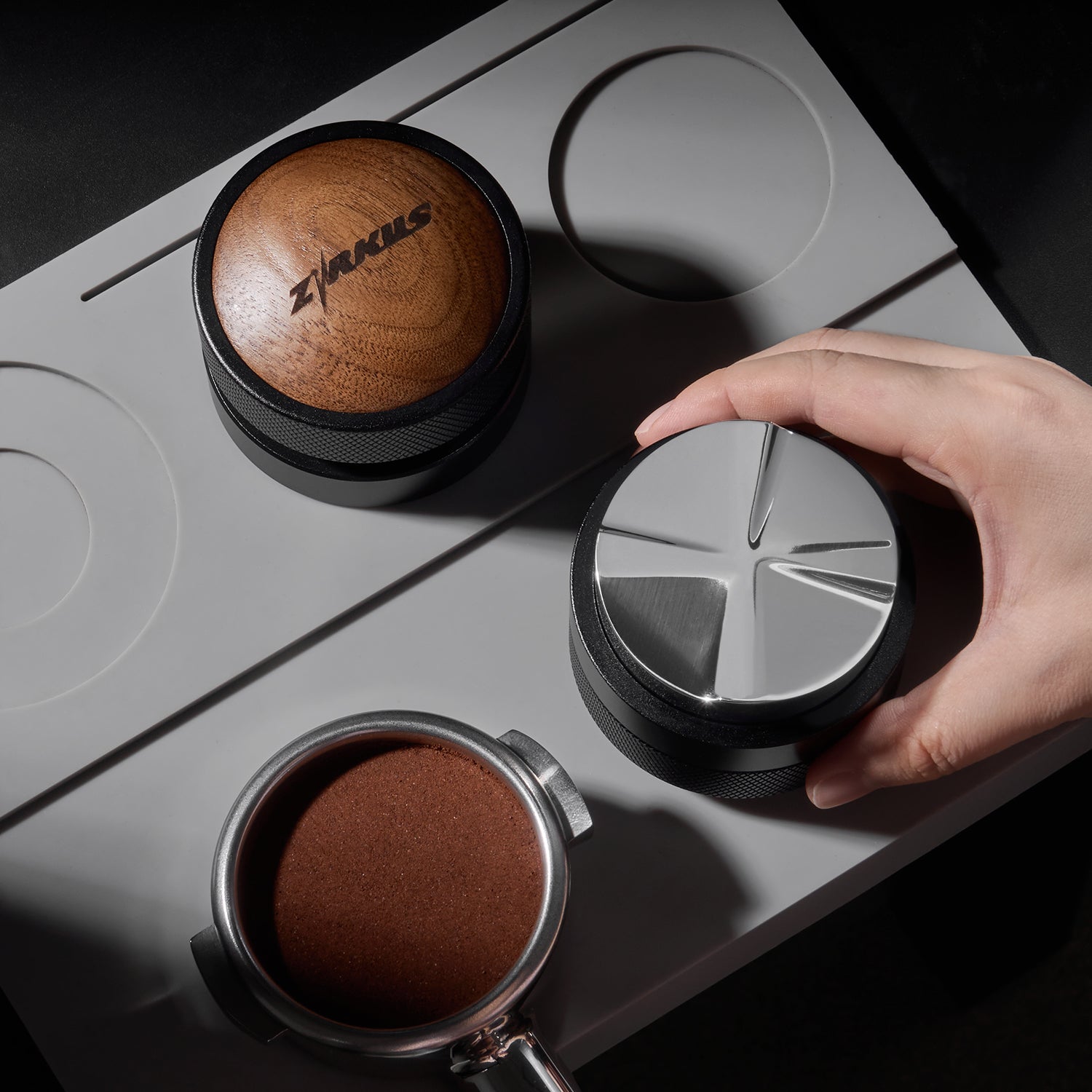
A WDT tool, espresso distributor and tamper are not interchangeable. Each tool acts on a different part of puck preparation: WDT redistributes loose grounds throughout the basket, a distributor levels the surface, and a tamper compresses the coffee into a stable puck.
In this section, “distributor” refers to a blade- or wedge-style surface-leveling tool, not a rotating needle WDT tool.
The correct order: Grind and dose → WDT → distributor (optional) → tamp → brew.
What Does Each Espresso Tool Do?
| Tool |
Main Job |
When to Use It |
What It Cannot Replace |
WDT Tool
Full-bed distribution
|
Breaks up clumps and redistributes loose coffee from near the bottom of the basket to the surface. |
Immediately after grinding and dosing, while the coffee is still loose. |
It does not compress the coffee and cannot replace tamping. |
Distributor
Surface leveling
|
Levels or smooths the top of the coffee bed before tamping. |
After WDT and before tamping, if you choose to use one. |
It does not reliably redistribute coffee throughout the deeper layers of the puck. |
Tamper
Final compression
|
Compresses the distributed grounds into a level, stable espresso puck. |
Last, after all distribution and surface-leveling steps are complete. |
It cannot correct clumps or uneven density already trapped inside the coffee bed. |
How to Use Them in the Correct Order
-
Grind and dose: Add coffee to a clean, dry portafilter basket. A dosing funnel can help prevent spills during WDT.
-
Use WDT: Gently distribute the coffee through the full depth of the basket, then finish with smaller movements near the surface.
-
Settle the grounds: Remove the dosing funnel and, if necessary, use one gentle vertical tap to settle the coffee. Avoid hard or sideways tapping.
-
Use a distributor only if needed: Keep it shallow and use it only to level the surface. If it noticeably compresses or pushes coffee around the basket, it is set too deep.
-
Tamp last: Apply a level tamp to fully compress the puck, then brew. Do not use WDT or a distributor after tamping.
Do You Need All Three Tools?
No. For many home baristas, careful WDT followed by a level tamp is sufficient. A surface distributor is optional and may add little after effective full-depth WDT. If you use one, its purpose should be light surface leveling—not additional tamping.
If you are wondering whether WDT should be used before or after a distributor, the answer is before. Using WDT afterward would disturb the leveled surface and make the distributor step unnecessary.
Bottom line: WDT distributes, a distributor levels, and a tamper compresses. For the simplest effective workflow, use WDT first and tamp last; add a surface distributor only if it provides a clear benefit in your routine.
Which ZIRKUS WDT Fits Your Workflow?
The best WDT tool is not necessarily the most automated one—it is the tool you can use correctly and consistently. Start with your basket size, then decide how much manual control, mechanical assistance or automation you want in your daily espresso workflow.
Quick recommendation: Choose the Flick WDT for maximum control and portability, the Push-Down model for an accessible rotary workflow, the Gear Rotation model for guided mechanical coverage, the V4 Springback for an integrated 58mm setup, or the Electric WDT for automatic operation with minimal hand movement.

Manual · Most flexible
ZIRKUS Flick WDT Tool
Best for: Home baristas who want direct control, compact storage and a tool that is not tied to one nominal basket diameter.
- Six retractable 0.4mm needles
- Pen-style body for controlled manual movement
- Compact and easy to store or carry
Consider: It requires a consistent hand pattern and takes slightly more practice than a guided rotary model.
View Flick WDT Tool

Rotary · Everyday speed
ZIRKUS Push-Down Rotary WDT
Best for: Users who want a faster guided movement without moving to a gear-driven or electric mechanism.
- Available in 51mm, 53mm and 58mm
- Eight-needle rotating mechanism
- Magnetic attachment and adjustable working height
Consider: Select the correct size and adjust the needle depth for your basket and coffee dose before use.
View Push-Down WDT

Gear-driven · Guided coverage
ZIRKUS Gear Rotation WDT
Best for: Home baristas who prefer a controlled mechanical needle path and an organized countertop setup.
- Available in 51mm, 53mm and 58mm
- Ten 0.35mm needles with a planetary gear mechanism
- Magnetic dosing funnel and storage base included
Consider: The mechanism and storage base use more counter space than a handheld manual WDT tool.
View Gear Rotation WDT

Springback · Integrated 58mm setup
ZIRKUS V4 Springback WDT
Best for: 58mm users who want press-to-rotate operation, automatic spring return and an integrated dosing-ring workflow.
- Designed exclusively for 58mm baskets
- Twelve-needle rotating system
- Adjustable needle depth, magnetic dosing ring and storage base
Consider: This model is 58mm only, so it is not suitable for 51mm or nominal 54mm setups.
View V4 Springback WDT

Electric · Minimal hand movement
ZIRKUS Electric Auto-Rotation WDT
Best for: 58mm users who prioritize automatic operation, speed and minimal manual movement.
- Designed for 58mm baskets
- Magnetic-induction automatic start and stop
- Nine fine distribution needles plus a central stabilizing pin
Consider: It is battery-powered and requires more care around its moving and electronic components than a manual tool.
View Electric WDT
Check compatibility before ordering: Handheld WDT tools are less dependent on nominal basket diameter, but rotary, gear-driven and electric models must match your portafilter setup. A 53mm option may be used with certain nominal 54mm baskets, so confirm your machine model and the selected product variant.
Whichever mechanism you choose, adjust the needles to reach through the coffee bed without forcefully scraping the basket.
FAQs
Q1: Do I really need a WDT tool for espresso as a beginner?
If you want consistent, balanced espresso (and less wasted coffee), yes! A WDT tool fixes clumping and uneven grounds—common beginner mistakes that cause bitter/sour shots. It’s an affordable, easy upgrade for home baristas.
Q2: Is a manual or electric WDT tool better for beginners?
For most beginners, a classic manual stir WDT tool is best. It’s cheap, easy to control, and helps you learn the basics of puck prep. Electric models are great but unnecessary unless you brew espresso frequently.
Q3: How often should I clean my WDT tool?
Clean it after every 2–3 uses! Simply wipe the stainless steel needles with a dry cloth to remove coffee grounds. For deeper cleaning, rinse with warm water (avoid soaking the handle if it’s wooden/plastic).
Q4: Can a WDT tool replace a tamper or distribution tool?
No—they serve different purposes. A WDT tool breaks clumps and evens grounds before tamping; a tamper compacts grounds, and a distribution tool levels the surface. A WDT tool pairs well with both, but doesn’t replace them.
Q5: Will a WDT tool make my espresso taste better immediately?
Yes! Most beginners notice a difference right away—thicker crema, less bitterness, and more consistent flavor. Just follow the step-by-step usage guide to avoid common mistakes (like stirring too fast).
Conclusion
You don’t need complicated, expensive gear to make great espresso at home. Sometimes the smallest accessory makes the biggest difference.
A WDT tool is simple to use, budget-friendly, and instantly fixes one of the biggest hidden reasons for bad espresso: uneven ground distribution and clumping. For any home barista beginner, learning to use a WDT tool is one of the easiest upgrades to level up your daily coffee routine.




Leave a comment
This site is protected by hCaptcha and the hCaptcha Privacy Policy and Terms of Service apply.